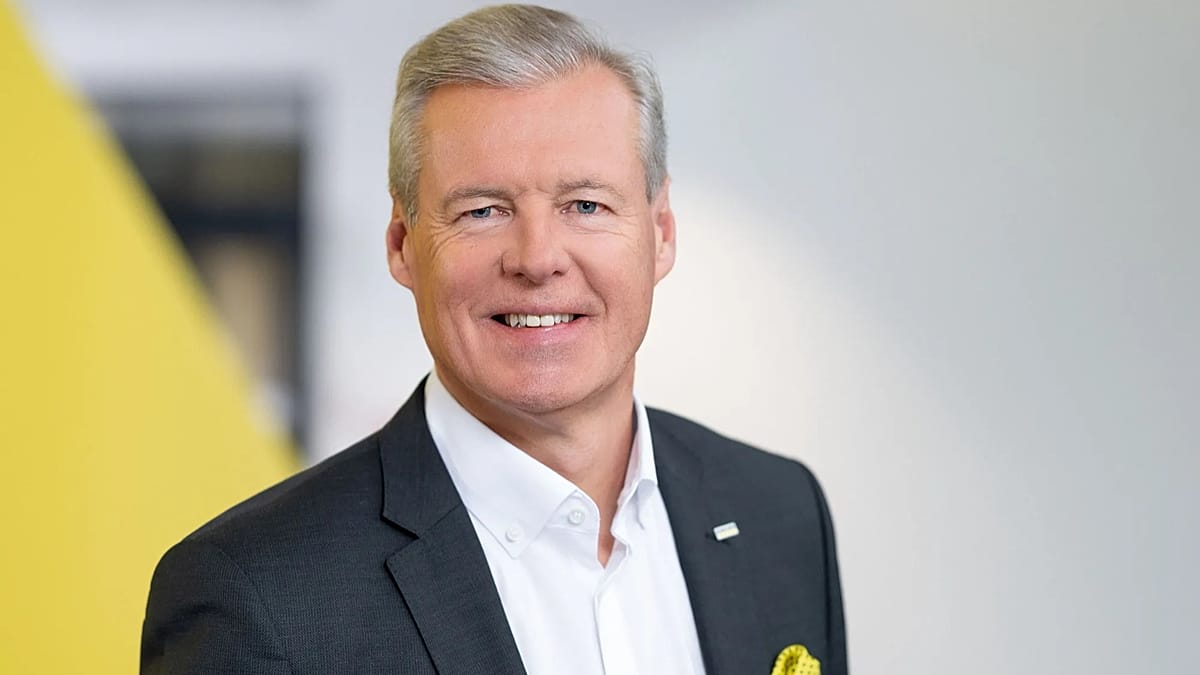
Kärcher CEO Hartmut Jenner warns of a perfect storm facing Europe, urging major cuts in bureaucracy, incentives for extra work, and a firm EU trade policy towards China and the US.
Jenner, 61, has been the head of Kärcher since 2001 and has tripled both staff numbers and turnover in that time. He believes Germany and Europe are facing a "perfect storm" when it comes to the economic situation facing the continent.
"Geopolitical crises are casting a shadow over the European economy. The unpredictable trade policy of the U.S. keeps threatening, without warning, to raise tariffs and erect trade barriers – a toxic scenario for free global trade and export-oriented companies," he wrote in an exclusive opinion piece for Euronews.
US and China are making fair competition 'virtually impossible'
In addition to US trade policy, the executive also pointed to the threat posed by China's tech growth: "China is no longer merely a low-cost manufacturer but has become a highly aggressive technological competitor that, with its tremendous speed, threatens to outpace key European industries in future-oriented fields," he wrote.
China's success is the result of a targeted state industrial policy. The country operates with massive subsidies in strategic key industries and with a "currency policy artificially focused on competitiveness," per Jenner.
Both help contribute to "noticeable market distortions and overcapacity," he went on.
For privately run companies like Kärcher, this creates an imbalance "that makes fair global competition almost impossible," Jenner added.
Germany faces the threat of deindustrialisation
"The loss of tens of thousands of industrial jobs and the decline in production volume show that deindustrialisation is not an abstract threat – it is happening right now."
"When plant closures and production relocations are being negotiated in key German industries such as the automotive and manufacturing sectors, it must be clear even to the most optimistic observer: We are at a critical turning point," he continued.
So far Kärcher has managed to make it through these difficult moments, Jenner said.
The company invests heavily in research and development, setting benchmarks in cleaning robots, battery technologies and the digitalisation of all areas of the business.
According to the company, more than 1,000 employees worldwide work in research and development.
Kärcher was founded in 1935. In 2025, the company generated almost €3.5 billion in turnover. The firm, which is still family owned, earned 86% of that abroad.
Kärcher's portfolio comprises more than 3,000 products related to cleaning and care, with its high-pressure cleaners particularly well known.
The company's headquarters are in Winnenden in the state of Baden Württemberg. It operates in 87 countries and employs 17,000 people around the world.
Business conditions and unfair competition making new jobs uneconomical
Yet even "innovation leaders" as Jenner describes his company cannot always prevail against "increasingly challenging operating conditions."
In view of sharply rising structural and labour costs, new production facilities and additional jobs in Germany and Europe are barely economically viable, he said.
Accordingly, Jenner is taking the German government to task.
Forecasts of 1.3% economic growth in Germany are "cautiously optimistic," but he warned that people should not be fooled by them, arguing it was "borrowed growth" - artificially driven by government debt, defence orders and subsidies.
"A short-term boost fueled by debt is no substitute for a real, self-sustaining recovery in private investments," Jenner wrote for Euronews.
"The causes of the ongoing weakness are largely homegrown: a creeping reform fatigue and a regulatory frenzy on the part of government institutions that hinders rather than facilitates investment," he added. "Instead of promoting entrepreneurship, regulations from Brussels to Berlin are suffocating the courage to embrace change."
Jenner grew up as the youngest child on his parents' farm in Winnenden. He studied business administration and engineering and continued to work on the family farm alongside his studies until he joined Kärcher in 1991 as an assistant. Hard work was instilled in him on the family farm.
"Success doesn’t just fall from the sky; for me, it consists of 97% hard work and dedication, 2% talent, and 1% luck."
His conclusion: "If we want to secure our prosperity and our social standards, we must once again recognize that value creation is the precondition for prosperity – and not the other way around. If you rest, you rust – that applies to people just as much as it does to economies."
Fight against bureaucracy, more work and determined trade policy
The Kärcher boss is therefore calling for "a real fitness programme for Germany."
Above all, rigid rules, excessive bureaucracy, high energy costs and steadily rising non-wage labour costs are poison for Germany as a business location, he argued.
But instead of tackling the problem at its root, a flood of regulations is allowed to continue, tying up valuable working time and costing companies millions, Jenner went on.
"Money and personnel that are needed for core business operations and innovation are being wasted on documentation requirements alone."
Cosmetic corrections are not enough, he said, what is needed is a cultural shift in the administrative apparatus, with authorities acting as service providers for business, pragmatic, fast and supported by AI.
"If other countries are already moving toward eliminating reporting obligations overall, this must send a clear signal to Germany and all Europe."
People should not shy away from necessary labour market debates either, Jenner stressed, adding that "demographic trends require an increase in the overall volume of work in the economy."
"Incentives for overtime, flexible working hours, practical rules regarding continued pay during medical leave, and a noticeable reduction in bureaucracy when employing skilled workers are essential."
Jenner is also calling on the EU to pursue a "resolute trade policy at the European level that guarantees fair competition and consistently punishes rule-breakers – because free trade only works when everyone follows the same rules."
Jenner's conclusion is that Germany's and Europe's future competitiveness can only be secured if they move away from bureaucracy and back to a "can-do mentality."
"Less regulation, more personal responsibility, ambitious investment incentives, reliable framework conditions, and, above all, the courage to tackle issues properly and comprehensively once again. Real change begins in the mind – it’s time to act."
Reactions
"Could not agree more! I have 2 high pressure car-washers from them and on both of them it is printed 'made in china' ..."
*"So, he moved production to China. China already owning the industrial value chain behind his “German” products knew exactly how to make better ones at the same or lower price point, otherwise known as “innovation”.
Worse part is China is probably using German/European industrial machines (a strong export we still have) to make a lot of these products that are competing with “European” ones.
All in all, to be fair, his message is not entirely dumb. He’s just a terrible messenger."
*"Karcher: German for More Plastic Shit."
*"I wouldn't say they're 'shit'. They're good, and that's the reason I have few products from them and they're all working well. They're not beaten in the sense I am not using them in industrial fashion, but they deliver what I ask them to do."
*"Oh no, CEOs moved everything to China to boost quarterly profits and now face consequences. Poor poor millionaires. Should not give them out any incentives without nationalization or share split between workers. Bailing out the fuckers isn't why I pay my taxes (hopefully)."
*"The unpredictable trade policy of the U.S. keeps threatening, without warning, to raise tariffs and erect trade barriers – a toxic scenario for free global trade and export-oriented companies
but barely a few lines later let's erect trade barriers because
China is no longer merely a low-cost manufacturer but has become a highly aggressive technological competitor that, with its tremendous speed, threatens to outpace key European industries in future-oriented fields
So free global trade and export-oriented companies only when
We are the ones doing it
When we don't have too get off our ass to earn it
0 ideas about improving the EU internal market, merging capital markets or harmonizing laws because clearly that would also not let him be complacent..."
*"Free trade is a good idea when you have someone watching to make sure no one abuses their power too much. Unfortunately all three last US Presidents- including Obama - had no issue letting the WTO rot to pieces and surprise, China is now making bank."
*"Yeah so China is doing the exact same thing Germany is doing in Europe this entire time...."
*"What eaxctly did Germany do?
Did they steal the recipe for Greek olive oil and then started producing their own?"
*"No, Germany benefited from adopting the euro, which was much weaker than the Deutsche Mark likely would have been, giving its exports a major competitive advantage. Add cheap Russian gas and Schröder’s Agenda 2010 reforms, which expanded the low-wage sector and suppressed labor costs, and you have a system that allowed German industries to undercut competitors across Europe."
*"letting China into the WTO was the original sin."
*"Not really. By the time they entered… they already were a large enough economy. Our problem never has been China at the root, they’re just making money and have far too much influence as a result… our problem was we did not hold our uber rich elites accountable and they moved everything they could offshore to make a buck, and we loved it in the vain hope some of the greenbacks would trickle down to us. Instead we got showered in piss."
*"Without China in WTO, 2008-2009 GFC would be way worse than it is."
*"It is so good to hear someone state ‘we are doing it.’ Business around the world saw easy profits with cheaper manufacturing. Bonuses for the management for years ensued. What we got largely is poorer-made products because the Western companies needed ways to take home more profit (take advantage of the consumer was the answer) was to reduce the quality of goods. I’m not sure if the exact timeline but I’d guess Walmart optimized this most effectively at least for the retail market. China smartly recognized that to improve their quality of life was to improve education, which they did, and skills to compete globally. Where are we now? China is starting to outpace us technologically. The circle is almost complete. We (Western) governments allowed companies to virtually unrestrictedly to create these unrestricted Global problems. Meanwhile, of course there are unfair Chinese business practices, Trump blames China and the U.S. companies get (almost totally) free ride, or the tariffs have loopholes easy to drive an aircraft carrier through.
I’ve oversimplified it because if you look at wages during this time they have not increased at the rate of inflation, and an exponential take home of $ goes to fewer and fewer."
*"China hasn’t started to outpace us. China has been outpacing us for quite some time, has strategic advantages (cheaper, younger workforce, rare earths, citizens who just toe the line) and has made the investments European countries can’t agree on bc fear of their fear and misunderstanding of debt (research, electrification, renewables)
Just visit. Things are far worse than most of us imagine."
*"Average age between China and Europe is only 4 years apart (40 Vs 44). Europe has rare earth deposits but won't exploit them due to regulations. Chinese wages when adjusted for purchasing power parity sit between eastern Europe and Spain/italy
It's largely policy decisions that are making the difference."
*"Why should we not put our own economy first? The EU and EU countries should protect our economy and not serve the interests of foreigners, be them Russian, Chinese or American. These countries wanted a multipolar world. We need a give them one, but on our terms."
*"First start making waps that spend more time in function than in servicing and then we can talk about bigger problems."
*"I bought a small Karcher steamer and it was fucked from day 1. I eventually took it apart and found they had skipped o-rings in the assembly so it didn’t work. The device only he about 5 components."
*"Heh mine stopped working a week ago or so after maybe half a dozen times of use in two years. Thanks for the hint, I’ll investigate if something is missing in mine as well."
*"Yes, your plastic covered water pumps can be done at the same quality but cheaper in china now. Guten morgen."
*"As can any other job.
No reason to pay any of you, in any job, more than Chinese median wage."
*"It’s not even the wages. Wages in South East Europe and Balkan countries are now lower than in Chinese industrial hubs.
Some low tech stuff will be easy to copy and then make a cheaper version of something slightly better, especially if there are already a few factories of the same stuff on your soil.
But even that is only part of the problem. Overcapacities, making ten factories when you only need five is how you manipulate prices as to take control of entire markets. This is what China does, and that is why being a Chinese entrepreneur in traditional industries is not so lucrative."
*"Also, the median earning of a German CEO is ~ 12 times that of a Chinese CEO. That’s where the cuts should come in first."
*"I do not know where you got those Numbers from. The Median Pay of a german CEO is between 120-195k€. Where the top income is distributed to less than 1% of CEOs. For Chinese CEOs there are no official numbers. But based on the cost of living etc. it’s assumed to be around 80-105k€ for production and 250-300k for tech CEOs."
*"What a load of nothingness. Just platitudes and vague doomsday scenarios. Less bureaucracy to catch and punish more rule breakers, solid plan /s. Working more won't do jack if the work is not paying enough wages from which the money can be taken to pay into the health and care insurances. But who cares, the important part is that we are worried enough to accept the dismantling of labor laws and worker protection "cause the Chinese."
*"Kränzle is the only way to go for high pressure. Just repaired a "non pro" device that is 42 years old. For the floor it is Nilfisk.
Kärcher sucks. Repairing their stuff is difficult and replacement parts very expensive."
*"This is going to be an interesting christmas, the way things seem to be going. Or not. Still, tension is now resulting on spontanous protests across multiple countries."

